The skills communicators can’t outsource
By Prachi Shailendra, SCMP
Professional communicators are increasingly adopting AI into their daily work. But what happens when machines decide what’s human? In this article, Prachi Shailendra explores the “new learning curve” of working with AI as a tool while maintaining human thinking and high standards, and what communications professionals can focus on at different career stages.

I recently discovered that one way to prove you’re human on the internet may be to make your work, to put it delicately, slightly worse.
I wish I were joking. But listen to this.
The episode
Last month, I wrote a Google review after a collaboration. I wrote every word myself. I took the photographs myself. And yet, the review simply wouldn’t publish.
While this was extremely amusing, it was also mildly infuriating. And for someone who has spent more than a decade working in communications, certainly unexpectedly educational. Somewhere between writing for people and publishing for people, there is now another audience we have to understand: machines deciding what looks human.
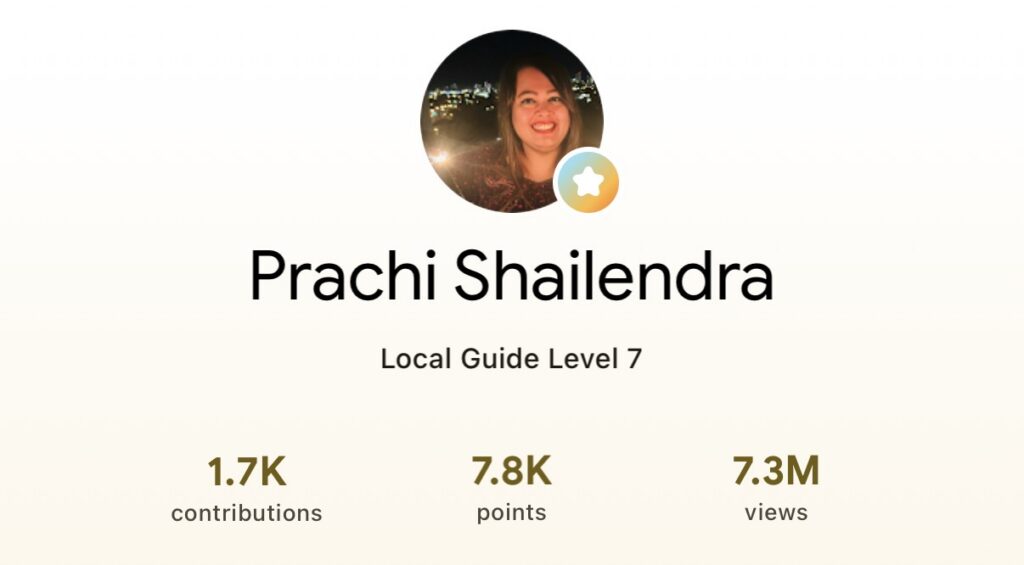
I enjoy reviewing places and experiences. My reviews and photographs on Google have more than 7.3 million views. And I’ve been reviewing places and experiences since the pre-AI era. I write about what I actually experience, use photographs I take myself and, like most real, authentic, educated and trained writers, edit my own writing before I publish it.
So, when this review wouldn’t go through, I experimented. I changed words, removed phrases, rewrote sentences I was originally perfectly happy with and, eventually, a version went through!
I don’t know exactly what triggered Google’s systems in this instance, nor would I pretend to understand the specifics of the algorithm. What I do know is that I had to dumb myself down and change my writing style in an attempt to convince a machine that it was human.
There is such irony in that. Especially for someone like me who is so dead against (ab)using AI for writing original pieces (my colleagues and friends will confirm this very strongly)! But there is also a professional question worth considering.
My second reaction: I actually want the guardrails!
(My first reaction was panic. I’m skipping the TMI of my overthinking brain here.)
AI can be extraordinarily useful. I use it too. One, because it’s a time-saver and two, because there is no escaping it. But there is a difference between using AI as a tool and simply outsourcing the act of thinking to it.
Say you are writing a note from a CEO after layoffs. AI can help you interrogate your draft: Have I buried the information employees actually need? Could this sentence be misread?
But asking it to “write an empathetic message to employees announcing layoffs” and publishing a lightly edited version is something else entirely. Honestly, I would personally feel like a scammer if I released that to my colleagues (ahem, ex-colleagues).
The problem isn’t grammar. AI gets that right, mostly. The problem is that the most important part of that communication — judgment — has been handed over. This distinction matters to me much more than whether someone “uses AI.” Which is why I appreciate that Google and other platforms are putting guardrails around content. And clearly, the concern is shared. A 2025 Canadian Journalism Foundation survey found that 88 per cent of Canadians are concerned about AI-generated deception in news. We should absolutely discourage spam, fake engagement and content manufactured at scale with very little human involvement.
But my experience showed me the awkward stage we are currently in: a system intended to protect authenticity can inconvenience someone creating something authentically while painfully obvious AI-generated content still gets published every day. The guardrails are necessary. They are simply not infallible.
My reactive learning from the episode
Most AI professional development I encounter starts with the tool. Interestingly, Microsoft and LinkedIn’s 2024 Work Trend Index found that 52 per cent of people using AI at work are reluctant to admit using it for important tasks. Perhaps we need to talk about responsible use before we get too excited about better prompts.
“Here is how to write a better prompt.”
“Here is how to summarize a document.”
“Here is how to generate 10 social posts in 30 seconds.”
Useful? Absolutely.
Enough? I’m sure anyone can answer that without asking AI.

Our professional development needs to include what happens before and after the prompt. Imagine asking AI to summarize a 60-page consultation report. Before that summary reaches a briefing note, go back to the source. Did “some participants” become “participants”? Did an important qualification disappear? That verification is the work.
Need for deliberate professional development at all stages
At this stage of my career, the aim of my professional development is not limited to learning how to use the newest tool. Statistics Canada reported in 2026 that 32 per cent of Canadian businesses using AI provided training to existing employees. But how much of that training goes beyond learning the tools? I need it to make me better at deciding when to use it, when not to use it and what I remain accountable for either way.
And that learning looks different depending on where we are in our careers:
- An early-career communicator may need to learn that an AI-generated source, quotation or statistic doesn’t exist simply because it looks legitimate.
- A mid-career communicator may need to decide where AI genuinely saves time and where that efficiency introduces risk.
- Those of us leading communications have another responsibility altogether: setting the standard for what good use looks like.
Leading the learning
Once you are leading communicators, the question is no longer only how you use AI. You are also helping other people decide how they should use it. That requires enough psychological safety for someone to say, “I used AI for this part,” without worrying that the admission itself will be judged. But it also requires clear expectations:
- If someone on my team uses AI to brainstorm 20 subject lines and then applies their judgment, fine.
- If AI summarizes research, I expect the original source to be checked and attributed.
- If it produces a statistic, I want that statistic traced to a credible source before it gets anywhere near approval.
- And if the work involves a sensitive stakeholder relationship or an issues-management decision, I expect the communicator to know when efficiency needs to take a back seat to human judgment.
For me, that’s simply part of leading the function now. AI may change how the work gets done, but it doesn’t change what I’m accountable for when that work goes out the door.
The human lesson
I recently received a serious email from a colleague and struggled to take it seriously. Not because the issue wasn’t serious. It genuinely was. But through all eleven Oxford commas, seven em dashes forcing my brain to take a 0.3-second break every few seconds and multiple neat little triads, all I could see was an untouched ChatGPT reproduction.
That is a serious communications problem (especially for a communicator)!

If your audience is thinking about the tool that wrote your message instead of the message itself, the tool has stopped helping. So yes, as communicators, we do need to use AI. But I also want us to learn how to edit it, question it and most importantly, recognize when we don’t need it.
I know what I sound like. I interrupt myself. I use parentheses when I have a side thought I apparently cannot keep to myself. And sometimes, I start a sentence with an “And” because that is how I would actually say it in real life. I don’t want professional development to train those things out of us. I want it to make us better at knowing which parts of our work technology can improve without handing over the parts that made us human communicators in the first place.
More than a decade into this profession, and as an SCMP® certified communicator who has led teams and communications functions, a stubborn Google review managed to teach me something new. There is no career stage at which we get to declare ourselves fully developed.
The tools will change. So professional development does require learning a sophisticated new technology. And sometimes it requires knowing enough to tell that technology: No. Actually, I like my sentence better when it starts with “And”.

About the Author
Prachi Shailendra, SCMP® is an internationally award-winning communications leader with more than 12 years of experience across the corporate and non-profit sectors. Her work has spanned five countries across Asia, Europe and North America, including multimillion-dollar initiatives in corporate social responsibility, human rights, child protection and poverty alleviation.
A journalist by training, she has worked closely with CEOs and senior leaders to shape communications strategy, bringing people together around ambitious goals and building teams that can turn those ambitions into reality. Her experience also includes leading communications for organizations working in settlement services, disability inclusion and women’s empowerment.
A former vice-president of IABC/Toronto, Prachi mentors newcomer professionals through TRIEC Mentoring Partnerships and high school students through Ontario Career Lab. Outside work, she believes in the therapeutic powers of kickboxing, good storytelling and an exceptionally well-made peppermint mocha.
Return to the November Edition 2026 Issue of Communicator
READ MORE
AI at Work
By Alice Namu You’re using AI. But are you using it right? AI can do more than save time. Explore how communicators can use AI strategically to improve workflows, […]
The Quiet Rewrite
By Sachi Hegde How AI Actually Changed My Working Week, 18 Months In The impact of AI on Sachi Hegde’s work was subtle rather than immediate. Over time, it […]
Collaborating with Machines – How I Started Using AI to Write Blogs
By Eric Emin Wood Can AI make you a better writer? Discover how Eric Emin Wood uses AI tools to streamline blog creation while keeping human creativity and judgment […]
The Human Write: Protecting Craft in the Age of AI
By Karen Traboulay, MBA, ABC, CCMP As AI reshapes communications, Karen Traboulay discusses how communications professionals can maintain trust, authenticity and craftsmanship while embracing change. I attended […]
Hosting the World: How Canada is Communicating Ahead of FIFA World Cup 2026
By Mohammad Akkawi, VP, Professional Development & Networking, IABC/Toronto What does it take to prepare a city for the world’s biggest sporting event? Mohammad Akkawi recaps a recent IABC/Toronto […]
Beyond the Text: Risk, Culture and Emoji Intelligence
By Caterina Lucia Valentino As AI begins to handle our “standard” writing, the way we use emojis has become our new digital body language. In this article, Caterina Valentino […]